

How Much Solar Do You Need to Run an RV Air Conditioner?
A real-world breakdown of running watts, starting watts, and the battery + panel setup it takes to keep cool off-grid.
There's a specific kind of disappointment that comes from arriving at a beautiful, off-grid campsite in July, flipping on the air conditioner, and watching your power station shut down or your generator stall. RV air conditioners are, by a wide margin, the hungriest appliance most rigs carry — and they don't just sip power, they demand a hard jolt of it the instant the compressor kicks on.
If you're trying to figure out whether solar can realistically keep your RV's A/C running — and if so, how many panels and how much battery capacity that actually takes — the math isn't complicated once you know the right numbers. The tricky part is that most RV owners only ever see one number on the spec sheet (the BTU rating), when what actually determines your power setup is watts: specifically, running watts and starting watts.
At PowerGen Store, this is one of the most common questions we get from RVers shopping for solar. Below, we'll walk through the watt ranges for the two most common RV A/C sizes, show you how to size a battery and panel setup around them, and point you toward real panel and power station combinations that can handle the load.
Running Watts vs. Starting Watts: Why Both Matter
Every RV air conditioner has two power numbers, and confusing them is the #1 reason people undersize their solar or battery setup:
- Running watts — the steady power draw once the compressor is already spinning and the unit is just maintaining temperature.
- Starting watts (surge watts) — the short, sharp jolt of power needed for a split second to get the compressor motor moving from a dead stop. This spike typically lasts well under a second, but if your power source can't deliver it, the unit simply won't start — even if your battery has plenty of capacity for running it.
This is the same reason a refrigerator or a power tool can trip a household breaker on startup even though it runs fine afterward. The compressor has to overcome inertia, and that takes a disproportionate burst of energy.
RV Air Conditioner Power Draw by Size
The two most common rooftop RV A/C sizes are 13,500 BTU and 15,000 BTU. Published running and starting watt figures vary somewhat by manufacturer, compressor design, and whether a soft-start device is installed — but the ranges below reflect the consistent figures reported across multiple RV appliance and power-equipment sources.
Note: A small number of sources report starting surges as high as 4,800–5,000W on units without a soft-start device. These figures vary by compressor design, outside temperature, and altitude — always check the data plate on your specific unit (running watts and amps, or LRA — Locked Rotor Amps — for the most accurate starting draw) before finalizing a power system.
💡 Soft-Start Devices: A soft-start kit (sold separately, installed at the A/C unit) can reduce that starting surge by roughly 40–60%. For an RV running primarily on solar and battery power, this single upgrade often makes the difference between a power station that can handle the A/C and one that trips on startup every time.
Sizing Your Power Station: Two Different Specs
Running an RV A/C off a portable power station means matching two separate specs — and missing either one means the unit won't run, regardless of how much battery capacity you have:
- Continuous (rated) output must exceed your A/C's running watts, with headroom for anything else running at the same time (lights, fridge, fans, charging devices).
- Surge (peak) output must exceed your A/C's starting watts — even though that demand only lasts a fraction of a second.
Then there's runtime, which comes down to battery capacity (measured in Wh, or watt-hours). A rough rule of thumb: divide the power station's Wh capacity by your A/C's running watts to estimate hours of continuous runtime — before factoring in any solar recharging during the day.
Example: Running a 13,500 BTU Unit
- Running watts needed: ~1,300–1,600W continuous output minimum
- Surge watts needed: ~2,500–3,000W peak output minimum (more without a soft start)
- For roughly 3–4 hours of A/C runtime on battery alone (before solar input), you're generally looking at a power station in the 3,000–4,000Wh capacity range
This is squarely in the territory of large-format power stations like the EcoFlow DELTA Pro, Jackery HomePower 3000/3600 Plus, or Anker SOLIX F3000/F3800 Plus — units built with both the surge capacity and battery capacity to handle a rooftop A/C, not just lights and electronics. Browse RV & Van Life power solutions →
How Many Solar Watts Do You Actually Need?
Here's the part that surprises a lot of RVers: solar panels alone generally cannot keep up with an RV A/C in real time. A 15,000 BTU unit drawing 1,500–1,800W continuously would require an enormous, constantly-tracking solar array to match that load directly — well beyond what fits on most RV roofs.
In practice, solar's real job in this setup is recharging the battery between uses — topping off the power station's capacity during the day so you have a full charge available when you actually need to run the A/C (typically in the afternoon heat, or to take the edge off before bed).
A Practical Solar Pairing

A 400–600W solar array (two to three 200W panels, or a stackable portable kit) run during 5–6 hours of strong daily sun can generate roughly 2,000–3,600Wh per day under good conditions — enough to meaningfully refill a 3,000–4,000Wh power station after an evening of A/C use, assuming you're also drawing on it for other RV loads. The more sun hours and the larger the array, the faster that recovery happens.
For a personalized estimate based on your specific A/C and travel patterns, try PowerGen Store's RV Solar Panel Calculator →
Solar Panels for RV A/C Charging
PowerGen Store carries panels from Renogy and RICH SOLAR built specifically for RV use — both as flexible/portable units and standard rooftop-style panels for a fixed array.
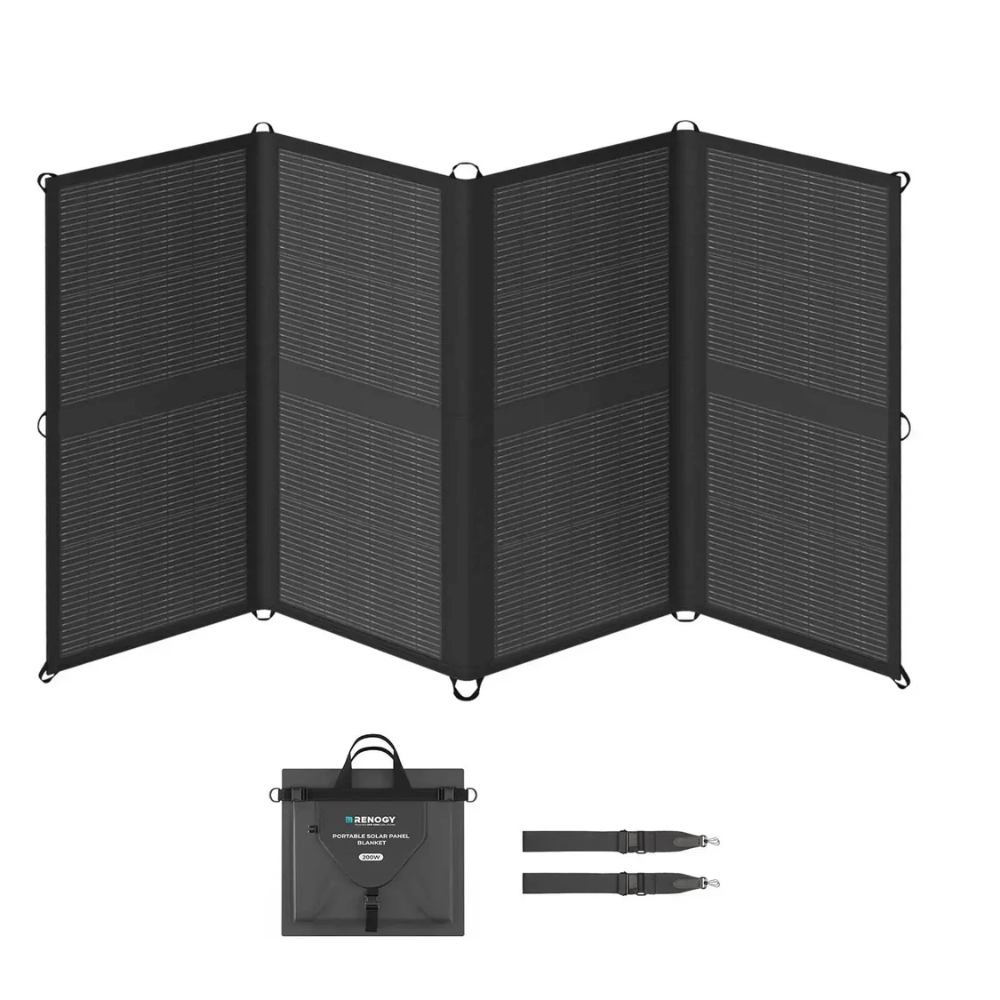
Renogy 100/200/300W Portable Solar Blanket
A multi-fold, lightweight solar blanket with selectable output (100W, 200W, or 300W depending on how far it's unfolded). N-Type cells for higher efficiency, built-in USB-C/USB-A ports, and mounts to a truck camper, windshield, or ground stake.
Shop the Renogy Solar Blanket →Renogy 200W Flexible Solar Panel
A flexible-mount panel rated for roughly 1,000Wh of daily energy generation under standard sunlight, with 25-year output durability. Good fit for a semi-permanent rooftop array on curved or irregular RV roof surfaces.
Shop the Renogy 200W Flexible Panel →RICH SOLAR MEGA 200W Portable Briefcase
A foldable, kickstand-equipped 200W briefcase panel built for ground deployment beside the rig — useful for parking in shade while still charging via solar.
Shop the RICH SOLAR MEGA 200W Briefcase →RICH SOLAR MEGA 250W Monocrystalline Panel
A higher-output fixed panel for building out a more substantial rooftop array. Two or three of these panels in parallel can meaningfully speed up daytime recharging for A/C-heavy travel days.
Shop the RICH SOLAR MEGA 250W Panel →Quick Decision Guide
If you only run the A/C occasionally (a few hours a day, mild climates):
A mid-size power station (2,000–3,000Wh) paired with a 200–400W portable panel setup can usually keep up.
If you run the A/C for extended periods or in consistently hot climates:
Plan for a large-format power station (3,000Wh+) with surge capacity well above 3,000W, plus a 400–600W+ array — and seriously consider a soft-start device for the A/C unit itself.
If you're not sure where your specific A/C falls:
Check the data plate on the unit for running watts/amps and LRA (Locked Rotor Amps), or use PowerGen Store's RV Solar Panel Calculator for a personalized estimate.
Build the Right RV Power System
Whether you're starting with a single portable panel or building a full rooftop array, PowerGen Store's team can help you match the right solar and battery combination to your RV's air conditioner. Fast and Easy Shipping on every order.
Shop RV Solar at PowerGen Store